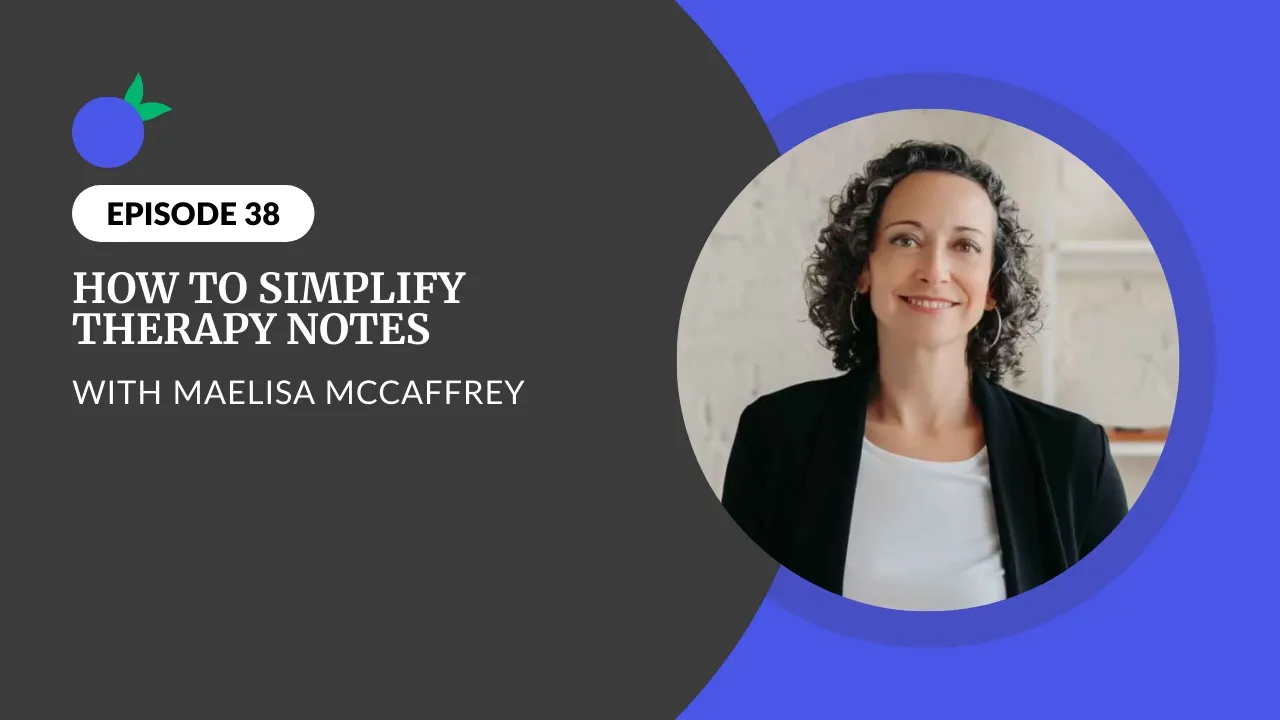
Maelisa McCaffrey is a licensed psychologist, the founder of QA Prep, and the author of Stress-Free Documentation for Mental Health Therapists. Before she was teaching clinicians how to write better notes, she was the person reviewing them - working in quality assurance at a large agency, training hundreds of therapists, and noticing the same thing again and again: almost nobody had ever actually been taught how to document.
We talked with her on the Berries podcast about why documentation feels so heavy for so many clinicians, and what actually helps. The conversation stayed with us not only for the specific tips - though there were plenty - but also for what it revealed about why this part of the job feels disproportionately stressful.
Here's what stayed with us.
Lesson 1: Vague Guidelines Create Real Anxiety
Most ethics codes give clinicians one real instruction about documentation: write notes. Beyond that, there's little concrete guidance about what actually belongs in them, especially for therapists seeing the same client weekly - a rhythm that looks nothing like the medical models much of the existing guidance was built around.
That vagueness isn't a technicality. For a profession largely made up of conscientious people who want to do things correctly, ambiguity becomes its own stressor - especially with no way to check a note against a peer's, since notes stay confidential. The anxiety many clinicians feel isn't a sign they're doing something wrong. It's a predictable response to an unclear task with no feedback loop.
Lesson 2: "What's Your Source?" Is Always a Fair Question
One useful reframe from the conversation: whenever a documentation rule gets repeated as gospel, it's worth asking where it actually came from.
Therapists carry many "rules" - no check boxes, insurance only reimburses certain modalities, every note needs a full mental status exam; it could be that it's not a payer requirement but a supervisor's workaround after a rough audit, passed down until it hardens into fact. That doesn't make every inherited rule wrong, but it does mean it deserves scrutiny before it becomes another source of pressure.
Lesson 3: Individualization Matters More Than Format
A second, related reframe: alongside asking where a rule came from, it's worth asking whether it's actually useful for you.
Some documentation habits exist because a payer requires them. Others exist because they help a specific clinician think clearly - a check-in and check-out note might be essential for one therapist and unnecessary for another. The format matters far less than whether it serves the clinician and reflects the actual clinical work. That also means permission to drop what doesn't serve a purpose - a full mental status exam on a stable, familiar client may add time without adding clinical value.
Lesson 4: Structure Isn't the Enemy of a Good Note
There's a persistent myth that structure - check boxes, templates, fill-in-the-blank phrasing - signals corner-cutting to a payer or auditor. In practice, the opposite tends to be true. Reviewers may not look for elaborate prose; they're looking, quickly, for two things: is this client making progress, and do they still need care. Clear, scannable notes serve that better than dense narrative paragraphs.
What matters is specificity. A checked box labeled with a modality name describes a category of training, not what actually happened in the room - and that's where scrutiny is fair. A checked box or sentence starter that captures the specific technique used or emotion processed still carries real clinical information. Structure and individualization aren't opposites; the goal is making sure the structure still says something true and specific about the person being treated.
Lesson 5: The Real Standard Is Higher Than Empathy, Not More Paperwork
When it comes to what payers may be looking for, the standard isn't a particular modality - it's evidence that clinical training is being applied. Empathy, active listening, and a safe space are foundational to good therapy, but they aren't unique to a licensed clinician's training. What distinguishes a session is the specific clinical skill brought to it - the kind of intervention that required a graduate degree to learn.
That distinction is useful beyond compliance. It's a reasonable gut check for a clinician's own sense of their work, too - a reminder of the specific expertise being applied in a given session, separate from the relational qualities that matter in any caring relationship.
Lesson 6: The Most Common Mistake Isn't a Bad Note - It's No Note
One pattern comes up again and again in Maelisa’s work with clinicians: notes that simply never get written.
This tends to happen at opposite ends of the same problem. Some clinicians fall behind until the backlog feels too overwhelming to start. Others overcorrect - building longer, more detailed notes that try to incorporate every piece of feedback they've ever received - until the process becomes so effortful that it stops happening consistently either way.
Both patterns tend to trace back to the same belief: that a note has to be perfect or it isn't worth finishing. The more useful standard is simpler - a shorter, adequate note that actually gets written protects both clinician and client better than a perfect one that never does.
Lesson 7: Reducing Friction Changes More Than the Paperwork
Much of the conversation centered on how tools - AI-assisted documentation among them - actually help, and the answer wasn't only about time saved. For many clinicians, and especially those managing something like ADHD, the harder problem isn't the minutes a note takes. It's the energy it takes to start.
Having something already drafted, even imperfectly, removes the initiation barrier that can keep a note unwritten for days. That shift can show up elsewhere, too: clinicians who aren't mentally rehearsing what they'll document later often describe being more present with the person in front of them. This is something we hear often from clinicians using Berries - when the administrative weight of a session lifts, presence during the session tends to follow.
There's no single right method here. Some clinicians do best dictating after a session. Some prefer typing directly into a template. Some do best with paper - printing a template and filling it out by hand in a couple of minutes. The through-line isn't the tool. It's whether the method actually gets the note done without draining the clinician in the process.
A Final Thought
What comes through in this conversation isn't really about templates or software. It's about the gap between how much clinical and emotional weight this work carries, and how little structural support most clinicians receive for the parts of the job that happen after the client leaves the room.
Documentation isn't separate from clinical care - it's part of how that care gets protected, reviewed, and continued. But it shouldn't come at the cost of a clinician's energy, confidence, or presence with the next person they see. The clinicians who find peace with this part of the job aren't the ones who've mastered a perfect system. They're the ones who've given themselves permission to do it well enough, consistently, in whatever way actually works for them.
Listen to the full conversation with Maelisa McCaffrey on the Berries Podcast:
Berries Blog
Apple Podcasts
Spotify
YouTube
Connect with Maelisa McCaffrey:
Website: QA Prep
Book: Stress-Free Documentation for Mental Health Therapists
YouTube Channel
Instagram
LinkedIn
This article is for informational purposes only and is not a substitute for professional clinical judgment, supervision, or continuing education. Therapists should consult current clinical guidelines and use their professional discretion when applying this information to individual client cases.