
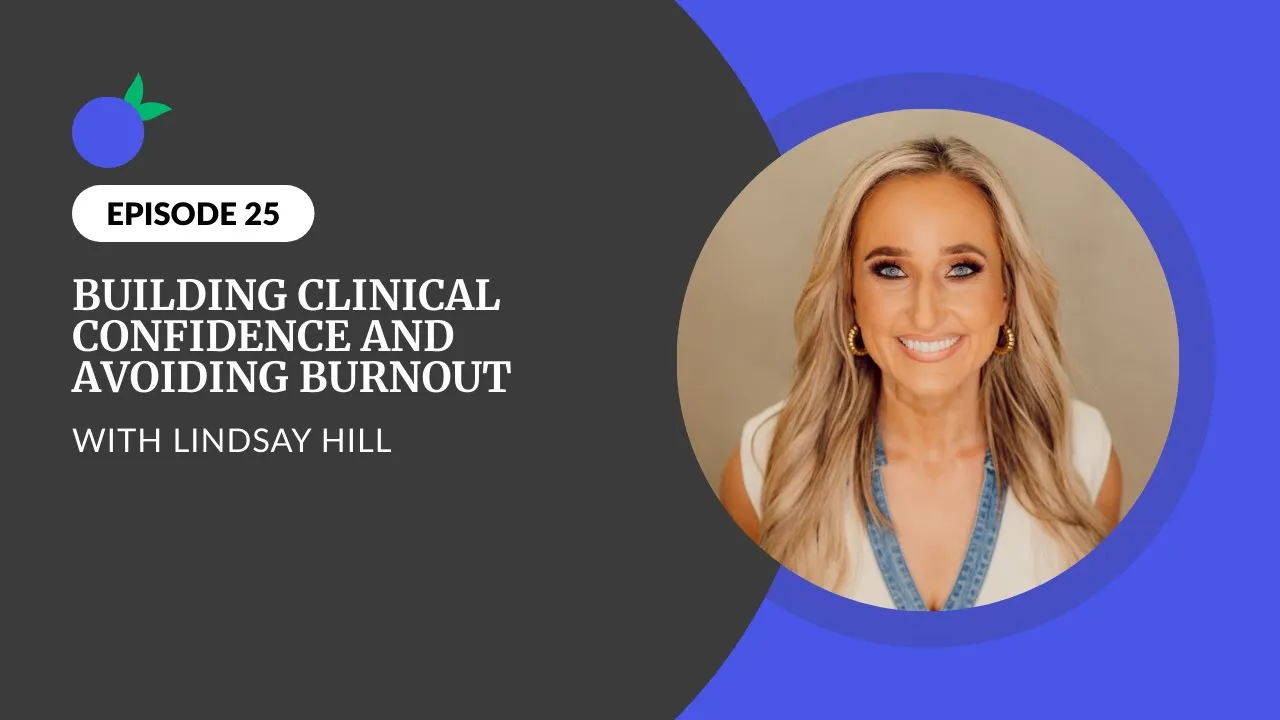
Dr. Lindsay Hill is a board-certified psychiatric nurse practitioner, educator, and founder of the PMHNP Bootcamp, a transition-to-practice program for new and mid-career psychiatric nurse practitioners. She's also co-founder of the PMHNP Network and president of the Arizona chapter of the American Psychiatric Nurses Association. We talked with her on the Berries podcast about the winding path from a corporate PMHNP role to private practice, the burnout that pushed her there, and the permission she eventually gave herself to build a career that didn't require sacrificing everything else.
The conversation covered clinical confidence, mentorship gaps, the business skills nobody teaches in school, and how she now uses AI tools in her own work. What stayed with us was how honestly she described stepping away from a version of success she thought she was supposed to want.
Lesson 1: Burnout Doesn't Always Look Like Exhaustion
Lindsay's shift away from a corporate PMHNP role didn't start with a plan. It started with a pandemic, a new baby, and a traumatic brain injury from a ski accident, all arriving around the same stretch of time. She took six months off and wasn't sure she could keep doing the work the way she'd been doing it.
Her burnout wasn't sudden. It built over years of back-to-back patient hours she'd absorbed as the standard, until a series of life disruptions forced a question she'd been avoiding. Burnout often doesn't announce itself early. It tends to surface once something else in life gives way first.
Lesson 2: Nobody Teaches the Business Side in School
Lindsay was candid about the gap between her PMHNP training and the reality of running a practice. Billing, reimbursement, marketing, hiring support: none of it was covered in her graduate program. She learned most of it by watching how the corporate employers she'd worked for handled things behind the scenes, then applying it herself once she went out on her own.
That gap isn't unique to her. Clinical training prepares PMHNPs to assess and treat. It doesn't typically prepare them to run a business, which means much of that learning happens after licensure, through trial and error, rather than through any formal instruction.
Lesson 3: Clinical Confidence Is Its Own Separate Skill
Lindsay pointed out that, in her experience, psychiatrists go through a residency, while PMHNPs don't have an equivalent standardized transition period. For her, that made the jump from graduate program to independent practice feel abrupt, and it's part of why she sought out a job with strong mentorship early on. She described feeling insecure about her clinical skills at the time and being deliberate about finding support before she felt ready to practice without it.
That's a reasonable response to a real gap, not a personal shortcoming. It's also the reason she built her bootcamp around structured mentorship and live coaching, so newer PMHNPs aren't left to figure out that transition entirely on their own.
Lesson 4: Your Practice Can Be Built Around Your Life, Not the Other Way Around
Lindsay described herself as someone who instinctively follows the expected path, until her sister, also a PMHNP, chose to work part-time and telehealth-only straight out of school. Lindsay's first reaction was closer to judgment. Her second reaction, eventually, was to notice that the choice actually fit her sister's life.
That reframe became a turning point. Lindsay later restructured her own practice around fewer consecutive patient hours and multiple income streams, not because it looked impressive, but because it let her show up better for her patients and her family. The lesson isn't that one schedule is correct. It's that the schedule most clinicians default to is often inherited rather than chosen, and it's worth asking whether it's actually serving you.
Lesson 5: Diversifying Income Can Be a Burnout Strategy, Not a Distraction From Clinical Work
Lindsay now splits her time between seeing patients, running her bootcamp, and coaching. She was direct that this wasn't purely a financial decision. Fewer consecutive patient hours meant more capacity for the emotional weight of the work itself, something she said still feels heavy even a decade into practice.
She also described real guilt attached to that shift: a worry that stepping back from a full clinical caseload meant she was chasing an easier lifestyle. What resolved it for her was returning to her original reasons for wanting more flexibility, more presence with her son, more sustainability in the work, rather than treating the shift as an indulgence. Diversifying revenue isn't inherently a retreat from clinical care. For some clinicians, it's what makes staying in clinical care sustainable at all.
Lesson 6: Reducing Friction Changes More Than Just Time
Much of the conversation touched on how Lindsay uses AI tools day to day, from clinical documentation to organizing her thinking before a talk. What came through wasn't just efficiency. She described years of typing notes in real time during sessions, and how different it feels now to be more present with a patient instead of mentally drafting documentation while they're still talking.
This is something we hear often from clinicians using Berries: when the administrative weight of a session lifts, presence during the session tends to follow. Lindsay also mentioned using a patient data platform that consolidates health history and wearable data in one place, which she said has made intake and follow-up visits easier when a patient can't recall details of their own treatment history. She was clear this is about having more complete information in front of her, not about any tool making clinical decisions for her.
A Final Thought
Lindsay's path wasn't linear, and she'd probably be the first to say so. It moved through community health nursing, a corporate PMHNP role, burnout, injury, private practice, and eventually into teaching other PMHNPs how to build careers that don't require the same trench-by-trench route she took.
What comes through in her story isn't a template. It's permission: to question a schedule you inherited rather than chose, to treat mentorship and business literacy as real gaps worth addressing rather than personal failings, and to let a career change shape in response to your actual life rather than a plan you set once and never revisited.
Connect with Lindsay Hill:
Website
Stan Store
Listen to the full conversation with Lindsay Hill on the Berries Podcast:
Berries Blog
Apple Podcasts
Spotify
YouTube